

From Inquiry to Order: How Super Secured Its First Dubai Client in the UAE Market
Case Type: New Overseas Client Development · Middle East (UAE)
Closing Time: March 2026
Client Location: Dubai, United Arab Emirates
Trade Term: FOB Shanghai
Shipping Method: Sea Freight (FCL/LCL Container), Shanghai Port → Dubai Port
Market Background – Demand for Import-Based Safety Equipment in Dubai
Dubai serves as a key trade hub in the Middle East, with active demand for imported industrial and safety equipment. Many distributors rely on overseas manufacturers for supply, making lead time, logistics feasibility, and pricing structure (FOB/CIF) critical decision factors.
For first-time cooperation, buyers typically prioritize:
Clear quotation terms (e.g., FOB Shanghai)
Verified export experience
Feasible shipping solutions (container compatibility, sea freight routes)
Client Profile and Application Scenario
The client is a Dubai-based distributor focusing on safety-related products. The inquiry was submitted via Super’s official website, indicating a direct procurement intent rather than general market research.
Key characteristics of the request:
Small initial quantity (“1 unit”) for trial order
Immediate request for FOB pricing
Strong focus on shipping method and container compatibility
This aligns with a typical low-risk trial order strategy used by new international buyers.
Solution Strategy – Price Structuring and Logistics Clarity
1. Flexible Quotation Approach
Super provided a quotation aligned with:
FOB Shanghai terms, matching client expectations
Trial-order-friendly pricing to reduce entry risk
Clear indication of factory location (near Shanghai), supporting logistics efficiency
2. Logistics Feasibility Confirmation
To address client concerns, the following technical points were clarified:
Shipping method: Sea freight (cost-efficient for bulky equipment)
Route: Shanghai Port → Dubai Port (mature international shipping lane)
Packaging: Compatible with standard shipping containers (20GP / 40GP)
These confirmations directly responded to the client’s questions:
“How to ship this?”
“Will it fit in shipping containers?”
3. Export Experience as Supporting Evidence
Super referenced prior shipments to Europe (e.g., Czech Republic), demonstrating:
Existing export handling capability
Familiarity with international packaging and documentation
Stable supply chain processes
Key Conversion Factors (Parameter-Based Analysis)
Factor
Practical Implementation
Fast response
Immediate confirmation of trade terms and pricing structure
Flexible entry strategy
Small-quantity trial order with manageable cost
Logistics transparency
Clear explanation of sea freight route and container suitability
Proven export experience
Reference to previous EU shipments
Geographic advantage
Factory proximity to Shanghai Port (reduced inland transport complexity)
Order Execution
After confirmation, the order was processed under FOB Shanghai terms and shipped via containerized sea freight.
Port of loading: Shanghai Port
Destination: Dubai Port
Transport mode: Ocean freight
Packaging: Standard export packaging suitable for container loading
The shipment was completed within the agreed timeline, with no structural or dimensional issues affecting container loading.
Client Feedback
Post-delivery feedback indicates:
Shipping arrangement met initial expectations regarding cost and feasibility
Product packaging and container loading were compatible with standard logistics operations
Communication during the transaction process was clear and responsive
Future Outlook – Expanding into the MENA Market
This first order establishes a baseline for continued cooperation. Discussions regarding follow-up orders are already in progress.
Dubai’s role as a regional hub provides potential access to broader Middle East and North Africa (MENA) markets, where similar procurement patterns and logistics requirements exist.
Key Takeaways
“Low-risk trial order + clear logistics solution + fast response = efficient conversion.”
Trial orders reduce decision barriers for new clients
Logistics clarity (routes, container fit, shipping method) directly impacts conversion speed
Demonstrated export experience builds trust in early-stage communication
Location advantage (near major ports) should be explicitly communicated
Upgrading Lithium Battery Charging Safety: A Manufacturing Facility Case Study with Professional Charging Cabinets
1. Background
With the widespread adoption of lithium-ion batteries in industrial environments, charging safety has become a critical concern. This manufacturing facility operates multiple electric forklifts and AGVs, requiring a centralized charging area.
However, the original setup revealed several risks:
Simultaneous multi-device charging with fluctuating electrical loads
Lack of fire-resistant physical isolation
Limited capability to detect early battery abnormalities
Industry data indicates that 67% of lithium battery fires occur during charging, prompting the company to upgrade its safety infrastructure.
2. Application Scenario
The project involves:
Forklift charging stations (8–12 units)
AGV charging zones
Battery maintenance workstations
The previous solution relied on standard sockets without dedicated safety systems.
3. Solution
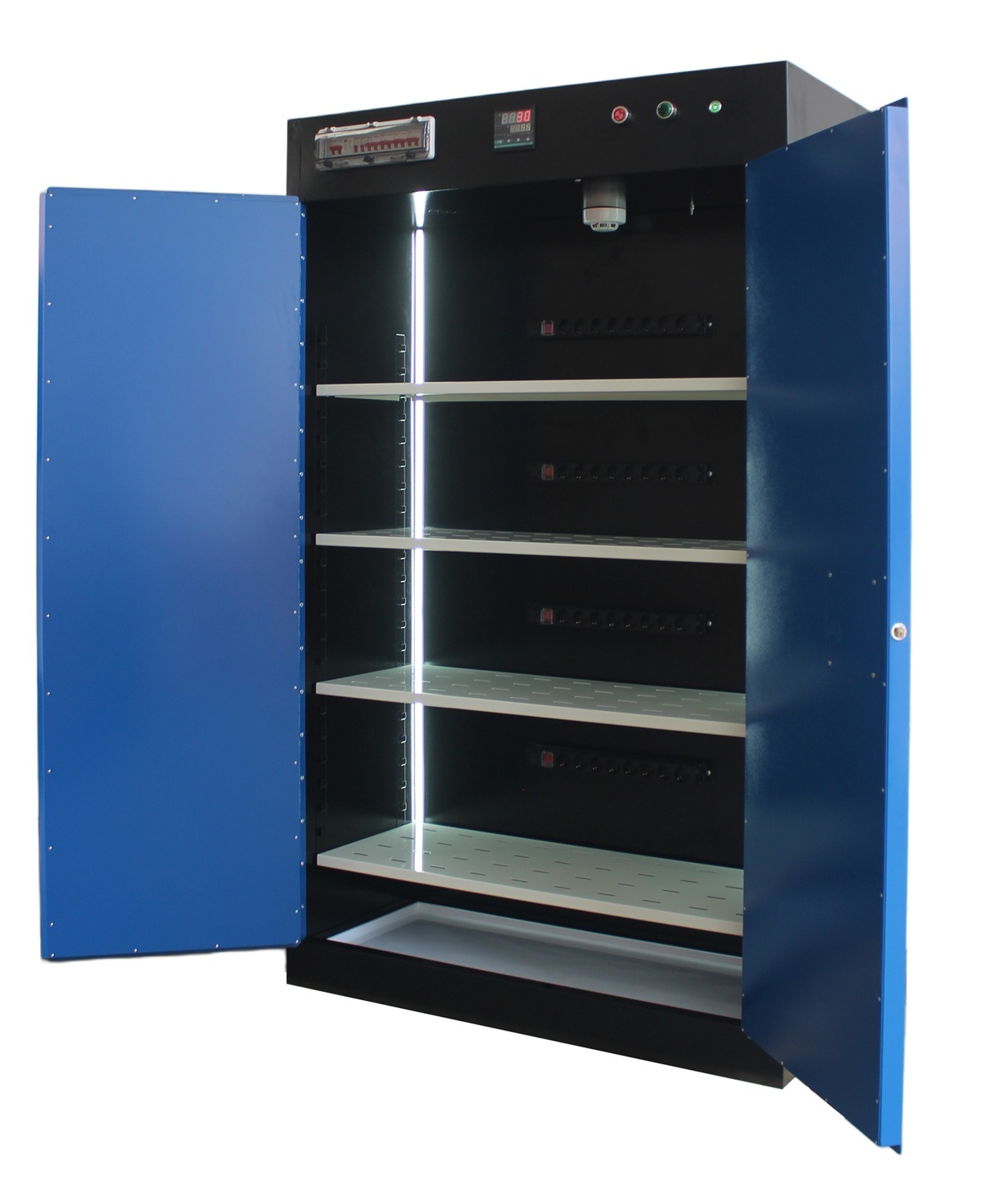
Professional lithium-ion battery charging cabinets were introduced, integrating the following systems:
Intelligent Charging Management
Real-time monitoring of voltage, current, and temperature
Automatic power cutoff under abnormal conditions
Temperature Monitoring
Multi-point NTC sensors (±1°C accuracy)
Instant alarm for temperature anomalies
Fire Suppression
Built-in aerosol fire extinguishing system
Response time < 3 seconds
Independent cabinet-level suppression
Smoke Detection & Ventilation
Early smoke detection
Forced airflow design (bottom intake + top exhaust)
Structural Design
Cold-rolled steel (≥1.0 mm)
Fire-resistant coating
Protection level: IP54
4. Key Specifications
Temperature accuracy: ±1°C
Fire suppression response: < 3 seconds
Material: Cold-rolled steel ≥1.0 mm
Protection: IP54
Ventilation: Forced convection
5. Results
After implementation:
Charging areas became independent safety-controlled units
Early detection of thermal and smoke risks improved
Fire risk shifted from reactive to preventive management
Compliance with internal safety audits was strengthened
6. Client Feedback
The client noted:
Stable operation across multiple battery types
Improved safety management processes
Clear technical compliance during inspections
7. Conclusion
This case demonstrates that integrating professional charging cabinets enables structured risk control in lithium battery charging environments.
Rather than being an optional upgrade, such systems provide multi-layered protection through measurable technical parameters, supporting safer and more compliant industrial operations.
Export to Australia: Practical Deployment of 250L Flammable Storage Cabinets for Compliant Industrial Use
1. Market Background
In Australia, hazardous chemical storage must comply with strict frameworks such as AS 1940. For flammable liquids (Class 3), key requirements include:
Fire-resistant containment
Vapor control and ventilation
Spill containment
Segregation and risk zoning
Non-compliant or open storage methods are increasingly being replaced by standardized safety cabinets.
2. Client & Application Scenario
The client is an Australian industrial company operating across production and warehouse environments, storing:
Industrial solvents
Oils and auxiliary chemicals
Key requirements:
Compliance with local safety regulations
Distributed storage within limited space
Improved accessibility with controlled safety risks
3. Our Solution
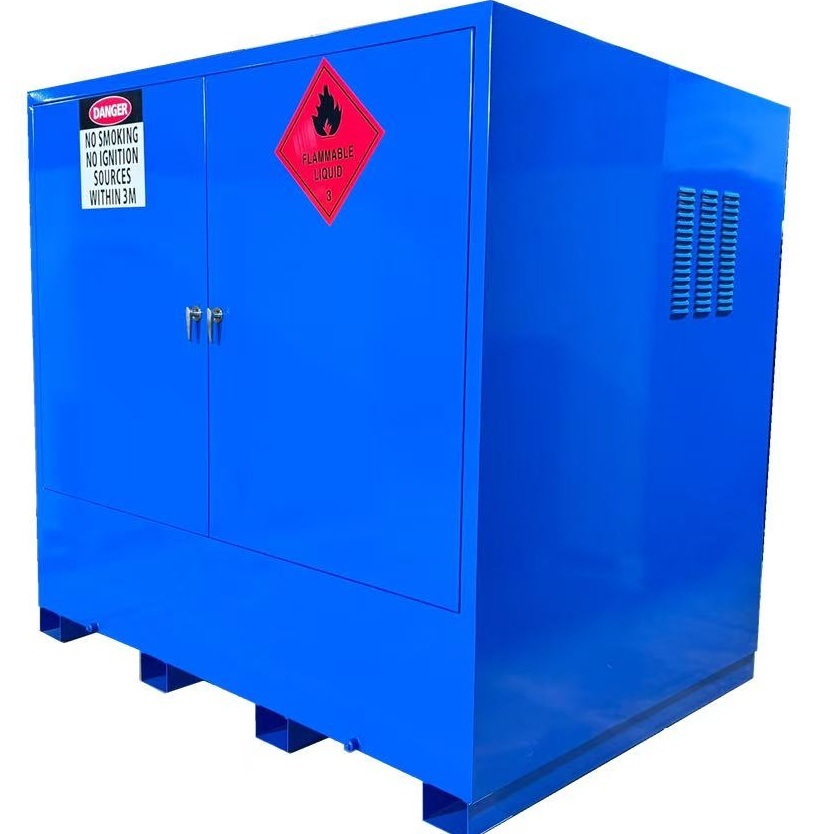
Model: 65-DGC250
Capacity: 250L per unit
Quantity: 22 units
Deployment: Distributed across workshop and storage areas
Core Strategy:
✔ Distributed storage to reduce centralized risk
✔ Capacity aligned with medium-volume chemical usage
✔ Design aligned with EN 14470-1 principles for global compliance adaptability
4. Key Technical Specifications
Structure
Double-wall steel construction (≥1.0 mm)
Insulation layer for thermal resistance
Epoxy-coated surface
Fire Performance
Designed in line with EN 14470-1 logic
Internal temperature control target ≤180°C
Self-closing doors (≤70°C trigger)
Safety Features
Spill containment sump
Ventilation ports
Grounding for static discharge
Usability
Suitable for 5L / 20L containers
Applicable to both workshop and warehouse use
Enables chemical segregation
5. Client Feedback
The client reported:
Improved accessibility with distributed cabinet placement
Better classification and management of chemicals
Stable structure suitable for daily industrial use
Effective spill and ventilation features for safety control
6. Conclusion
This export project demonstrates that:
Fire-rated storage cabinets are essential infrastructure in regulated markets
Distributed storage reduces overall risk
The 250L capacity offers a balance between flexibility and storage volume
For Australian and similar markets, cabinet selection should be based on standards, capacity, operating conditions, and risk level, rather than isolated specifications.